
Events & Actions
🌹 Tuesday May 19 (6:30 PM – 7:30 PM) Ecosocialist Bi-Weekly Meeting (zoom and in person at 1916 McAllister St)
🌹 Wednesdady May 20 (6:00 PM – 7:00 PM) Guarantee Act Petition Dropoff/Pickup (Mission Playground, 36 Cunningham Pl)
🌹 Wednesday May 20 (6:00 PM – 7:30 PM) 🐣 What is DSA? (1916 McAllister St)
🌹 Thursday May 21 (6:00 PM – 7:00 PM) 🐣 Social Committee (zoom)
🌹 Thursday May 21 (6:00 PM – 7:00 PM) Education Board Open Meeting (zoom)
🌹 Thursday May 21 (6:00 PM – 7:00 PM) Immigrant Justice Regular Meeting (zoom and in person at 1916 McAllister St)
🌹 Friday May 22 (9:30 AM – 10:30 AM) 🐣 District 1 Coffee with Comrades (2 Clement St)
🌹 Friday May 22 (7:00 PM – 9:00 PM) 🐣 Maker Friday (1916 McAllister St)
🌹 Sunday May 24 (11:00 AM – 1:00 PM) 🐣 Physical Education + Self Defense Training (Panhandle, William McKinley Monument)
🌹 Sunday May 24 (1:00 PM – 3:00 PM) 🐣 DSA Spring Picnic (William McKinley Monument, Panhandle)
🌹 Sunday May 24 (5:00 PM – 6:00 PM) 🐣 Tenderloin Healing Circle Working Group (zoom)
🌹 Monday May 25 (6:00 PM – 8:00 PM) 🐣 Tenderloin Healing Circle (Kelly Cullen Community, 220 Golden Gate Ave)
🌹 Monday May 25 (6:30 PM – 8:00 PM) Homelessness Working Group Regular Meeting (1916 McAllister St.)
🌹 Monday May 25 (6:30 PM – 7:30 PM) 🐣 DSA Run Club (McClaren Lodge, Golden Gate Park)
🌹 Monday May 25 (7:00 PM – 8:00 PM) Labor Board – Flex Meeting (zoom)
🌹 Tuesday May 26 (5:30 PM – 7:00 PM) Social Housing Working Group (zoom and in person at 1916 McAllister St)
🌹 Tuesday May 26 (7:00 PM – 8:00 PM) Public Transit Meeting (zoom and in person at 1916 McAllister St)
🌹 Wednesday May 27 (6:45 PM – 8:30 PM) Tenant Organizing Working Group Meeting (zoom and in person at 1916 McAllister St)
🌹 Thursday May 28 (6:30 PM – 7:30 PM) Public Bank Project Meeting (zoom)
🌹 Thursday May 28 (7:00 PM – 9:00 PM) 🐣 Bilingual Emergency Planning Training: How to Show Up for Immigrants at Their ICE Check-Ins (zoom and in person at 1916 McAllister St)
🌹 Friday May 29 (9:30 AM – 10:30 AM) District 1 Coffee with Comrades (in person at 2 Clement St)
🌹 Sunday May 31 (1:00 PM – 2:30 PM) What Is DSA? (in person at 1916 McAllister St)
🌹 Monday June 1 (6:30 PM – 7:30 PM) DSA Run Club (in person at McLaren Lodge)
🌹 Monday June 1 (7:00 PM – 8:00 PM) Labor Board – New Union Organizing (zoom and in person at 1916 McAllister St)
🌹 Tuesday June 2 (6:30 PM – 7:30 PM) Ecosocialist Bi-Weekly Meeting (zoom and in person at 1916 McAllister)
Check out https://dsasf.org/events for more events and updates.
We kicked off our campaign for the Affordable Housing Guarantee Act!
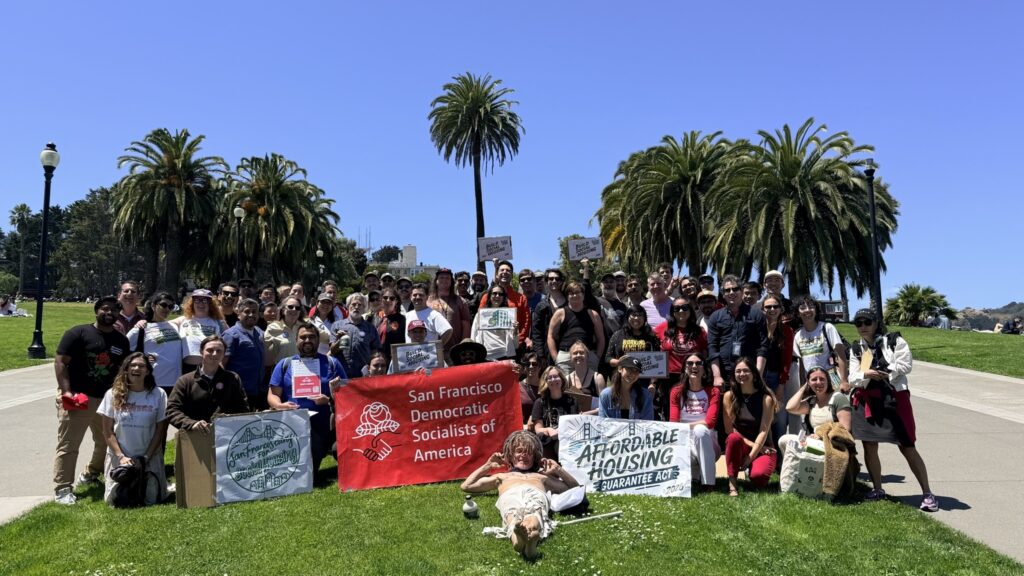
Come out to Mission Playground this Wednesday, May 20th anytime between 6 and 8 PM to drop off filled out petitions and pick up fresh petitions! We’ll train you in signature gathering and get you set up everything you need. Come help us guarantee our affordable housing funds!
Join our Community Forum for wide-ranging discussions
We’re holding our Community Forum from 12-3 at the DSA SF Office. This will be our first run of the event, so we’re focusing on members first before rolling out to a wider audience, and we’ll be soliciting feedback and suggestions from attendees.
The goal of the event is to facilitate a discussion around concrete issues that people are concerned about at the global, national, and local levels, to discuss how problems that seem distinct are often interconnected through the logic of capitalism, and how socialism can tackle these challenges by targeting the roots.
EWOC Fundamentals of Workplace Organizing Course: Reportback for Weeks 2-4
The four week long Fundamentals of Workplace Organizing course had its final session this past Sunday. Our cohort was 8 to 12 comrades strong and we learned about the building blocks of organizing. These trainings are run regularly, with the next one coming up Tuesdays in July. You can find out more details here!
During the second session, the big idea was “socialize before you organize.” Building real relationships with coworkers outside of work creates the trust you need before any organizing conversation can actually happen. We talked through the 80/20 rule, 20% asking questions and sharing, 80% listening. The goal isn’t to come in with your own list of issues, but to get curious about what your coworkers care about and let them articulate what’s wrong in their own words. From there, you can start connecting people to each other and turning individual frustrations into collective ones, since a problem affecting one worker likely affects another. We also got into some of the practical strategies as well, such as not having organizing conversations at work or on internal communications tools like slack, always updating your chart afterward (if you don’t write it down, it didn’t happen!), and never assuming someone will say no before you’ve actually had the conversation. A few people shared updates on their own charting, including one person starting a chart at their workplace who got connected with another attendee organizing at the same company! We wrapped up talking about what makes someone “organizable”, things like prior social connections or signs they care about a cause, and how to redirect hopelessness by pointing to workplaces where organizing has actually won.
The third week’s plenary focused on “Campaigns and Collective Action,” and after watching it together we dug into how an organizing committee actually moves from building relationships into running a campaign. A big theme was structure tests: the idea that every action doubles as a diagnostic for how much cohesion you actually have. You want to front-load smaller, lower-stakes actions (stickers, swag, socials, asking OC members to commit to 1:1s, getting a question upvoted at an all-hands, raising an issue in a visible internal forum) so that if something flops, it flops early and tells you where the gaps are. Someone made the point that in tech especially, demands tend to be more amorphous than in service-sector campaigns, so you often have to get creative about what counts as an action. We also talked about how the most common failure mode isn’t unclear messaging but workers not feeling like others have their back, which is really a 1:1 trust problem dressed up as a communication problem. Recruiting natural workplace leaders into the OC matters a lot, and tactics like anonymous-signature open letters can lower the risk threshold for people who are nervous about visibility. On scope, we got into how a campaign can carry a #1 and a #2 issue rather than shoehorning everyone into one demand, with the Starbucks example as a reference point (pay and benefits across the board, hours and scheduling shop-specific). Identifying the actual decision-makers, which often means going past your immediate manager to the board, shareholders, or execs, came up as something bosses actively try to obscure. We closed by touching on the spectrum from business unionism to class-struggle unionism, with the sense that tech organizing probably can’t stop at the business-unionism layer. Recommended reading from the discussion included *What the Boss Doesn’t Want Us to Know*, *Class Struggle Unionism*, and *Unions of Our Own*.
The final session went over inoculation, which is the practice of preparing your coworkers against common talking points the boss and anti-union coworkers may share. We used the Union Busting Bingo Card to practice responses and reasoning behind the canned responses that union busters will have. Our scenarios went over phrases including “We’re already making those changes”, “If you don’t like it then don’t work here”, “You can always come to us”, and “We’ll give you a pizza party <or any kind of small gimme>”. We also discussed how to respond to concerns about immigration/work status being threatened and the myth that unions only ask for raises so that they can get more union dues. The boss is your strongest organizer because inoculation can prove to your coworkers that the boss isn’t there to support the workers and that they’d rather read from a union-busting playbook than respond to worker demands.
If you’d like to get involved with the SF local chapter of EWOC, reach out to the lead coordinator Caitlin S or email labor@dsasf.org. EWOC is a standing topic at meetings of the Labor Board, which are held every other Monday at 7:00 PM, both in-person at 1916 McAllister and over Zoom. Anyone is welcome to attend, and we’re always looking for people interested In workplace lead canvassing, organizer trainings, and volunteer outreach. If you’re interested in organizing your workplace and would like to be connected with an EWOC organizer, fill out the request form here.